General rule
Iowa State's general guidance checks dryness about an inch below the surface and advises waiting another day or two if the soil still feels wet. Species specific preferences override that general rule.

Look it up. Track it. Get it done.
Add your plants, pick a type, and get your next watering dates. Free, no sign-up, and your list stays on your device only.
Checking the soil does not mean watering it. Check first, then water only when the soil at that plant's test depth is ready.
Moisture preferences, seasonal advice, and technique from extension and RHS sources, cited beside the content it supports.
Approximate depths that make general guidance usable day to day. They are labelled approximate unless a source specifies the depth.
Check intervals are editable product defaults to prompt an inspection. They are not research findings and not fixed watering schedules.
Start here
Push a finger into the mix to the depth listed for your plant. Damp at that depth means wait. The pot must have a drainage hole: gravel at the bottom does not replace one.
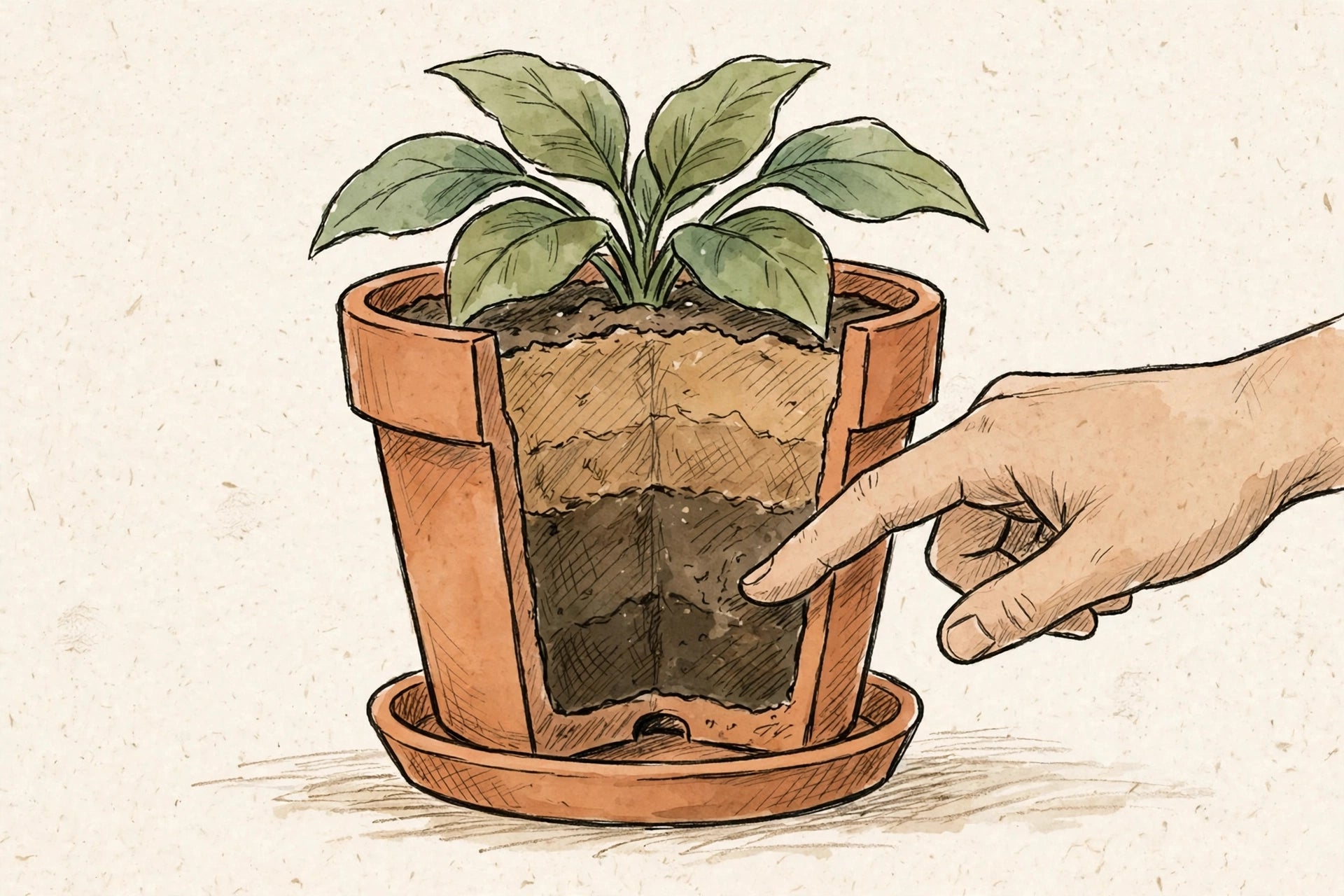
For many foliage plants, test 1 to 2 inches below the surface. If the soil is still damp at the plant's test depth, wait. Moisture loving ferns need shallower checks and should not dry throughout; plants requiring full dry-down need a deeper assessment, not just a dry surface.
Iowa State's general guidance checks dryness about an inch below the surface and advises waiting another day or two if the soil still feels wet. Species specific preferences override that general rule.
For Monstera, Penn State recommends watering thoroughly and letting the top 1 to 2 inches dry between waterings, so that depth is source-specified.
Ferns and moisture loving plants: surface to about half an inch, and never dry throughout. Full dry-down plants (snake plant, aloe, string of pearls) need the whole pot assessed. Pot weight and a wooden skewer are practical checks, not validated measurements.
Seasons
Check the soil before watering, and treat humidity care separately from root watering. There is no universal winter watering rule.
Active growth usually means checking more often. Warmth and greater activity can increase water use; a cool room generally needs less frequent watering than a warm one.
Reduced light may slow water use, but dry heated air can speed drying. Most indoor plants grow less actively in winter and need less water than in summer — a tendency, not proof every plant is dormant, per Iowa State Extension, Linn County.
Competing seasonal effects are why the tool uses actual soil condition, as noted by the RHS houseplant growing guide. Keep moisture loving plants on frequent inspection reminders in heated rooms — heating alone does not mean more water.
Pots
Containers need drainage holes. A decorative pot without a hole should hold a separate inner pot with holes, and collected water should be emptied rather than left around the roots (Penn State's repotting guidance). All pot materials can work when watering is adjusted, according to Iowa State Extension.
Porous and dries faster. Useful for dry-down plants or people who tend to overwater. Inspect moisture loving plants sooner.
Slower moisture loss through the sides. Useful for moisture loving plants or dry rooms. Check before repeating a watering.
Generally behaves like a nonporous pot. Confirm drainage, and distinguish a growing pot from a decorative outer pot.
Technique
The RHS advises room temperature water, watering thoroughly, allowing drainage, and emptying water filled saucers. Roots need air as well as water, so prolonged standing water is unsafe.
Iowa State Extension notes that misting raises humidity only briefly. Humidifiers, grouping plants, and suitable enclosed environments work better. This app does not set a daily misting task.
Per Wisconsin Horticulture, spider plant brown tips can come from low humidity, excessive dryness, salt buildup, or fluoride or chlorine in water. Distilled water or rainwater can help. Leaving water out does not remove fluoride or all treatment chemicals.
Browse all 20 species with moisture cues, soil tests, and sources.
